The supplement your gut has to earn
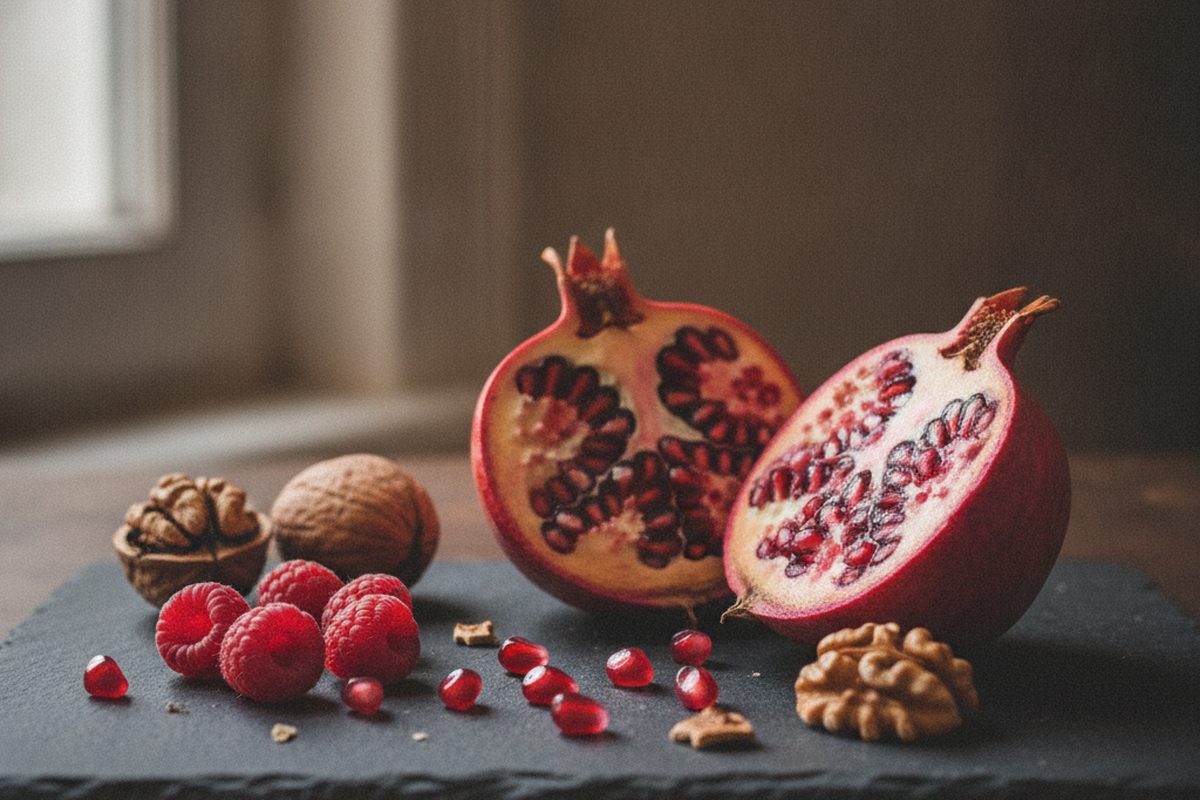
Here's a fun party fact that also happens to explain the entire urolithin A industry: you cannot eat urolithin A. It isn't in pomegranates. It isn't in walnuts. It isn't sitting in any food waiting to be absorbed. Instead, when you eat those foods, you're eating raw materials called ellagitannins, and if — if — you happen to host the right gut bacteria, those microbes ferment the raw materials into urolithin A somewhere down in your colon. It's less "superfood" and more "you supply the ingredients and hope your internal brewery is open."
And for a lot of people, it isn't. Estimates suggest only around 30 to 40 percent of us carry a microbiome capable of producing meaningful amounts of urolithin A from diet. So two people can eat the exact same pomegranate salad and end up with wildly different levels of the good stuff in their blood. That biological lottery is the whole commercial pitch for taking urolithin A as a supplement: skip the unreliable gut middleman and swallow the finished molecule directly. It's a genuinely logical argument — which, on a site like this, means we now have to go check whether the finished molecule actually does anything useful.
What it actually does: taking out the cellular trash
The reason longevity researchers care about urolithin A at all comes down to one clunky, wonderful word: mitophagy. Your cells are powered by mitochondria — thousands of tiny batteries per cell — and like all batteries, they degrade. A young, healthy cell has a quality-control routine that spots a broken-down mitochondrion, tags it, and recycles it for parts, making room for fresh ones. That cleanup crew is mitophagy (a specialized form of the "autophagy" self-cleaning process that won a Nobel Prize in 2016).
The problem is that this recycling program gets sluggish with age. Junk mitochondria pile up, cells get less efficient, and tissues that need a lot of energy — muscle, brain, immune cells — feel it first. This is where urolithin A struts in. In lab and animal work it acts as a mitophagy activator: it nudges cells to restart the clean-out, clearing damaged mitochondria and prompting the growth of new ones. In aging mice and worms, that translated into better muscle function and endurance. Nice for the worms. But you're not a worm, so the real question is whether any of this survives contact with an actual human clinical trial.
The part that's genuinely impressive: it holds up in humans
This is where urolithin A separates itself from the enormous pile of supplements that sound brilliant on a mechanism slide and then evaporate the moment someone runs a placebo-controlled trial. Urolithin A has actually been tested in people — repeatedly — and the results are real.
It started sensibly, with safety. A 2019 first-in-human study published in Nature Metabolism gave healthy elderly volunteers urolithin A at doses up to 1,000 mg a day and found it was well tolerated, absorbed properly, and — crucially — left a molecular fingerprint in the blood and muscle showing improved mitochondrial gene activity.[1] That's the unglamorous but essential first step: it's safe, it gets in, and it appears to do the cellular thing it's supposed to.
Then came the outcomes people actually care about. In 2022, a four-month randomized, placebo-controlled trial in middle-aged adults (published in Cell Reports Medicine) found that urolithin A improved muscle strength by roughly 12% compared with placebo, alongside better aerobic endurance and lower levels of inflammatory and mitochondrial-stress markers in the blood.[2] A separate randomized trial in older adults, published in JAMA Network Open, zeroed in on muscle endurance and mitochondrial health, and again found measurable improvements over placebo.[3] Two different age groups, two different research angles, both pointing the same direction. In supplement-land, that kind of consistency is rare enough to make you sit up.
And the story didn't stop at muscle. In late 2025, a randomized, placebo-controlled trial in Nature Aging — nicknamed MitoImmune — tested 1,000 mg of urolithin A daily for 28 days and reported that it shifted the profile of aging immune cells, expanding "naive-like," less-exhausted CD8+ T cells and boosting their metabolic fitness.[4] That's early, it's a short trial, and immune-cell markers aren't the same as "you'll get sick less." But it's a real, peer-reviewed human result extending the molecule's story from muscle into immune aging — and it's a big part of why urolithin A is having a moment in 2026.
Now the deflating part (there's always one)
So it's settled, buy the bottle? Slow down — this is a clean-longevity site, and clean means telling you where the plank gets thin.
First: every one of the "it works" studies measured surrogate outcomes — muscle strength, endurance, blood markers, immune-cell profiles. Those are meaningful and measurable, but not one of them shows that urolithin A makes a human live longer or even stay healthier for longer in any hard, disease-endpoint sense. "Improved my six-minute walk test over four months" is a legitimately good result. It is not "reverses aging," no matter how a landing page phrases it.
Second, follow the lab coats. A meaningful share of the strongest research is connected to Amazentis — the company behind Mitopure, the leading branded urolithin A. As with C15:0 and its maker, this doesn't make the science fake; these are real trials in real journals with placebo controls. But when the company selling the molecule is also funding much of the evidence for it, the honest move is to lean on the independent replications (which, encouragingly, do exist here) and keep waiting for more.
Third, the effect sizes are solid, not spectacular. A ~12% strength improvement over four months is worth having — especially past midlife, when muscle is quietly walking out the door — but it's an assist, not a transformation, and it won't outrun the basics. If you're not sleeping, not lifting anything heavier than your phone, and eating like it's a dare, no mitophagy capsule is going to save you. Which brings us to the reliably annoying takeaway.
The clean verdict
Urolithin A is, frankly, one of the more legitimately interesting molecules in the current longevity conversation — and unusually, it has earned that spot with human data rather than vibes. The mechanism (restarting your cells' mitochondrial recycling) is real and important, the safety profile so far looks good, and multiple randomized trials point in a consistent, positive direction for muscle and, tentatively, immune aging. That is a genuinely stronger evidence base than most things sold under the "anti-aging" banner.
But strong-for-the-category still isn't proof it will add years or even guaranteed healthspan to your life, and the price of a branded urolithin A supplement is not trivial. So here's the clean framing. If you're over 40, already nailing the free levers — sleep, resistance training, protein, cardio — and you have spare budget for an experiment with a real (if modest) evidence base and a reassuring safety record, urolithin A is one of the more defensible novel supplements to try. Give it a few months, notice whether your training stamina genuinely shifts, and be honest with yourself about the answer. If instead you're looking for the one pill that offsets a life you haven't sorted out yet, save your money and go for a walk in the sun — that lever is free, and the evidence for it is even better. Meanwhile, eating pomegranates, walnuts and berries is a delicious, no-downside bet regardless of which microbes you host. We'll update this page the moment the longer, harder-endpoint trials land.
Common questions
Urolithin A (formula C13H8O4) is a compound your gut bacteria make from ellagitannins — plant molecules in pomegranates, walnuts, raspberries and strawberries. You don't absorb it directly from food; your microbiome brews it after you eat those foods.[1] The catch is that only an estimated 30–40% of people carry the right gut bacteria to produce meaningful amounts, which is much of the rationale for taking it as a supplement.
"Maintain and improve function" is more accurate than "build." In a randomized trial in middle-aged adults, four months of urolithin A improved muscle strength by roughly 12% versus placebo,[2] and trials in older adults showed better muscle endurance and mitochondrial biomarkers.[3] These are real, measured effects on muscle quality and stamina rather than dramatic size gains — and no trial has shown it extends lifespan.
The human safety data so far look reassuring. The first-in-human trial found urolithin A was well tolerated at up to 1,000 mg per day,[1] and later trials used 500–1,000 mg daily for one to four months without serious safety signals. Long-term, multi-year data don't exist yet, so check with a doctor if you're pregnant, on medication, or managing a health condition.
References
- Andreux PA, Blanco-Bose W, Ryu D, et al. The mitophagy activator urolithin A is safe and induces a molecular signature of improved mitochondrial and cellular health in humans. Nat Metab. 2019;1(6):595–603. PubMed: 32694802. doi:10.1038/s42255-019-0073-4
- Singh A, D'Amico D, Andreux PA, et al. Urolithin A improves muscle strength, exercise performance, and biomarkers of mitochondrial health in a randomized trial in middle-aged adults. Cell Rep Med. 2022;3(5):100633. PubMed: 35584623. doi:10.1016/j.xcrm.2022.100633
- Liu S, D'Amico D, Shankland E, et al. Effect of Urolithin A Supplementation on Muscle Endurance and Mitochondrial Health in Older Adults: A Randomized Clinical Trial. JAMA Netw Open. 2022;5(1):e2144279. PubMed: 35050355. doi:10.1001/jamanetworkopen.2021.44279
- Denk D, Singh A, Kasler HG, et al. Effect of the mitophagy inducer urolithin A on age-related immune decline: a randomized, placebo-controlled trial. Nat Aging. 2025;5(11):2309–2322. PubMed: 41174221. doi:10.1038/s43587-025-00996-x
Study data sourced via PubMed.