The longevity molecule hiding in your breakfast
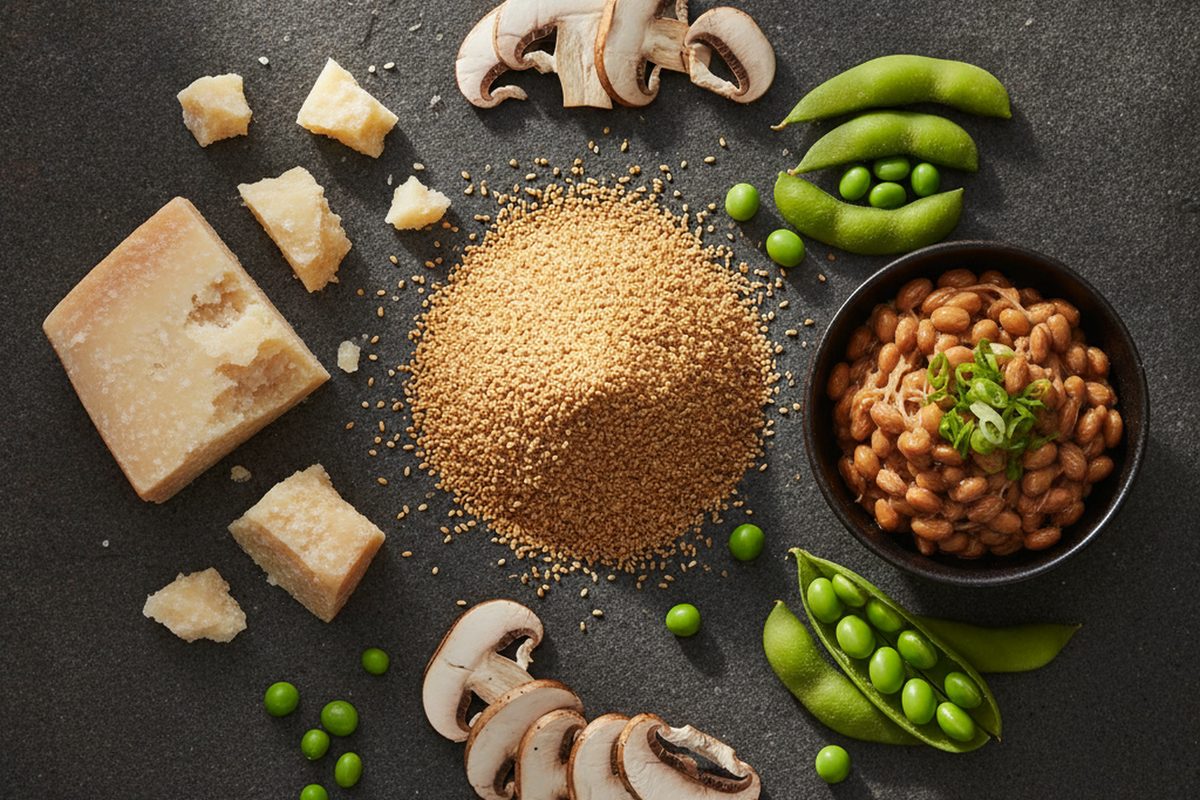
Most of the compounds we cover on this site arrive dressed in lab coats and venture capital: obscure molecules you'd never encounter without a supplement bottle. Spermidine is refreshingly different. It's already inside you — your cells manufacture it — and it's sitting in a surprising amount of ordinary food. That spoonful of wheat germ you could stir into yogurt? One of the densest natural sources on the planet. Aged cheddar, a bowl of natto, a handful of mushrooms, mature soybeans, whole grains: all quietly loaded with the stuff. Its name, admittedly, is the least appetizing thing about it — yes, it was first isolated from exactly the biological fluid you're now thinking of — but chemically it's just a humble polyamine, C7H19N3, doing quiet housekeeping in every cell you own.
So why is a molecule from your cornflakes suddenly one of 2026's most-searched longevity terms? Because spermidine sits at the intersection of two things longevity nerds can't resist: a genuinely elegant mechanism, and a set of population studies that make it look like a fountain of youth you can put on toast. Naturally, that's exactly the kind of claim a clean-longevity site is obligated to walk over to and poke with a stick.
What it actually does: the cellular self-clean
The reason scientists get excited about spermidine comes down to one word that also explains half the fasting content on the internet: autophagy. Roughly translated, it means "self-eating," which sounds alarming but is actually one of the most important maintenance routines your body runs. Inside every cell, junk accumulates — misfolded proteins, worn-out organelles, molecular debris. Autophagy is the cleanup crew that identifies the garbage, packages it up, and recycles it for parts. The Japanese scientist who mapped this process, Yoshinori Ohsumi, won the 2016 Nobel Prize in Medicine for it. It's the real deal.
The catch, as with most good things in biology, is that autophagy slows down as you age. The trash-collection routine gets sluggish, cellular debris piles up, and tissues start to run less cleanly. This is where spermidine struts in. In cell and animal studies it acts as a potent autophagy inducer — it nudges cells to restart the cleanup. That's why researchers file it under the wonderfully nerdy heading of "caloric-restriction mimetic": it appears to trigger some of the same protective cellular housekeeping that fasting or eating less does, without you having to skip lunch. In yeast, worms, flies and mice, feeding spermidine extended lifespan and improved markers of heart and brain aging.[4] Lovely for the mice. But you, dear reader, are not a mouse, so let's see what happens when this leaves the petri dish.
The epidemiology that turned heads
Here's the finding that put spermidine on the map. In 2018, researchers analyzing a long-running community cohort in northern Italy (the Bruneck study) reported something remarkable in the American Journal of Clinical Nutrition: over roughly 20 years of follow-up, people who ate the most spermidine had substantially lower all-cause mortality than those who ate the least.[1] The size of the gap is what made everyone sit up — the difference in death risk between the highest and lowest spermidine eaters was similar to being about 5.7 years younger. The team even validated the signal in a second, independent Austrian cohort. As far as "eat this, live longer" headlines go, this one had unusually solid bones.
But — and on this site there's always a but — this is epidemiology, which means it can show a link but never prove cause. People whose diets are naturally rich in spermidine tend to eat a lot of whole grains, vegetables, legumes and fermented foods. In other words, they eat like the people who show up healthiest in basically every nutrition study ever run. Untangling "spermidine did it" from "these folks also eat their vegetables, move more and smoke less" is genuinely hard, and the authors adjusted for a long list of those factors — but no statistical adjustment fully closes that door. It's a strong hint, not a verdict. Which is precisely why researchers did the obvious next thing: they ran actual randomized trials.
The part that quietly deflated the hype
This is where the spermidine story gets more honest and less Instagrammable. A first small pilot was encouraging: in 2018, a three-month trial in 30 older adults with subjective memory complaints found a moderate improvement in a memory task among those taking a spermidine-rich wheat-germ supplement versus placebo.[2] Promising! The same team, sensibly, went bigger to confirm it.
And this is the study that doesn't make it onto the supplement labels. The larger, longer follow-up — the SmartAge trial, published in JAMA Network Open in 2022 — ran for a full 12 months in 100 older adults with subjective cognitive decline, using a rigorous double-blind, placebo-controlled design. The result? Spermidine supplementation produced no significant improvement in the primary memory measure over placebo, and no clear change in the main biomarkers either.[3] The exploratory analyses hinted at possible benefits for verbal memory and inflammation, and the researchers themselves flagged that the dose — a modest 0.9 mg per day — may simply have been too low to move the needle. But you have to respect what a well-run negative trial is telling you: the early memory buzz did not survive a bigger, better test.
That's not a takedown of spermidine — it's the system working exactly as it should. A small pilot generates excitement; the larger confirmatory trial checks whether the excitement was real. Here, at that dose, over that year, it mostly wasn't. It's the same arc we've watched play out with other longevity darlings, from the taurine hype cycle to NMN's gap between raising a biomarker and actually slowing aging. Mechanism and epidemiology point one way; the hard randomized endpoint stubbornly refuses to fully cooperate.
So why is it still a 2026 story?
Fair question — if the big memory trial came up empty, why is spermidine trending now? Three reasons. First, the mechanism hasn't gone anywhere: newer lab work keeps deepening the case that spermidine does real, specific things inside cells, from boosting mitochondrial fat-burning to rejuvenating tired immune T-cells toward a more youthful, less "exhausted" state.[4] That's biologically the same territory that made urolithin A's mitochondrial story so interesting, and it keeps spermidine firmly in the "worth studying hard" column.
Second, the dose question is now being taken seriously. The SmartAge researchers essentially told the field "maybe we didn't use enough," and the field listened. A new generation of trials is testing far higher doses — a Danish cardiovascular study launched in 2024, for instance, is giving elderly heart-disease patients around 24 mg per day (roughly 25 times the SmartAge dose) and tracking hard outcomes like heart structure, exercise capacity and muscle mass, with results expected later in 2026.[5] Those trials are the ones actually worth waiting for.
Third — and let's be honest — "the longevity molecule in your cheese and cereal" is an irresistible story, and the supplement industry knows it. That's the part to keep your guard up around.
The clean verdict
Spermidine is one of the more genuinely plausible longevity compounds out there, and we don't say that lightly. It has a real, Nobel-backed mechanism (autophagy), strikingly consistent epidemiology tying higher intake to lower mortality, and a steady drumbeat of mechanistic work explaining how it might help. That's a stronger foundation than most things in the anti-aging aisle can claim. What it does not yet have is the thing that actually matters: a large, well-run randomized trial showing that taking spermidine makes humans live longer or stay sharper. The best controlled trial we have came up short, and the higher-dose trials that might change that verdict haven't reported yet.
So here's the clean framing. Eating spermidine-rich foods is a spectacularly easy, no-downside bet — wheat germ, aged cheese, mushrooms, natto, whole grains, legumes are all foods that show up on every sensible longevity plate anyway, and this is one more reason to enjoy them. That's the move with the best evidence-to-effort ratio by a mile, and it fits the boring truth we keep coming back to: most of longevity is built on a plate, not in a bottle. If you're also curious about the concentrated supplement, it appears safe and it's biologically defensible — just go in clear-eyed that you're funding an experiment, not buying a proven result, and don't let a pill distract you from the free levers that beat it. We'll update this page the moment the higher-dose trials land, because this is one longevity story where the most interesting chapter genuinely hasn't been written yet.
Common questions
Spermidine (formula C7H19N3) is a natural polyamine your own cells make and that's also plentiful in food. The richest dietary sources are wheat germ, aged cheeses, natto and other fermented soy, mushrooms, whole grains, peas and green soybeans.[1] Unlike many longevity molecules, you genuinely can eat meaningful amounts — a spoonful of wheat germ is one of the densest natural sources.
The epidemiology is encouraging: in a 20-year Austrian–Italian cohort, the highest dietary spermidine eaters had markedly lower all-cause mortality — a gap roughly equal to being 5.7 years younger.[1] But the best controlled trial to date, the 12-month SmartAge study using a low 0.9 mg/day dose, found no significant memory benefit over placebo.[3] So the honest 2026 read is promising signal, not proven effect — with higher-dose trials still underway.
Spermidine is part of a normal diet, and human trials using wheat-germ extracts — plus ongoing cardiovascular trials at around 24 mg per day — have reported good tolerability, with adverse events balanced against placebo.[3][5] Long-term, multi-year safety data are still limited, so check with a doctor if you're pregnant, on medication, or managing a health condition.
References
- Kiechl S, Pechlaner R, Willeit P, et al. Higher spermidine intake is linked to lower mortality: a prospective population-based study. Am J Clin Nutr. 2018;108(2):371–380. PubMed: 29955838. doi:10.1093/ajcn/nqy102
- Wirth M, Benson G, Schwarz C, et al. The effect of spermidine on memory performance in older adults at risk for dementia: A randomized controlled trial. Cortex. 2018;109:181–188. PubMed: 30388439. doi:10.1016/j.cortex.2018.09.014
- Schwarz C, Benson GS, Horn N, et al. Effects of Spermidine Supplementation on Cognition and Biomarkers in Older Adults With Subjective Cognitive Decline: A Randomized Clinical Trial. JAMA Netw Open. 2022;5(5):e2213875. PubMed: 35616942. doi:10.1001/jamanetworkopen.2022.13875
- Zimmermann A, Hofer SJ, Madeo F. Molecular targets of spermidine: implications for cancer suppression. Cell Stress. 2023;7(7):50–58. PubMed: 37431488. doi:10.15698/cst2023.07.281
- Thorup CV, Jeppesen CNA, Jensen TH, et al. POLYamine treatment in elderly patients with Coronary Artery Disease (POLYCAD): study protocol for a randomised, double-blind, placebo-controlled trial of spermidine versus placebo. Trials. 2025;26(1):452. PubMed: 41168834. doi:10.1186/s13063-025-09176-z
Study data sourced via PubMed.