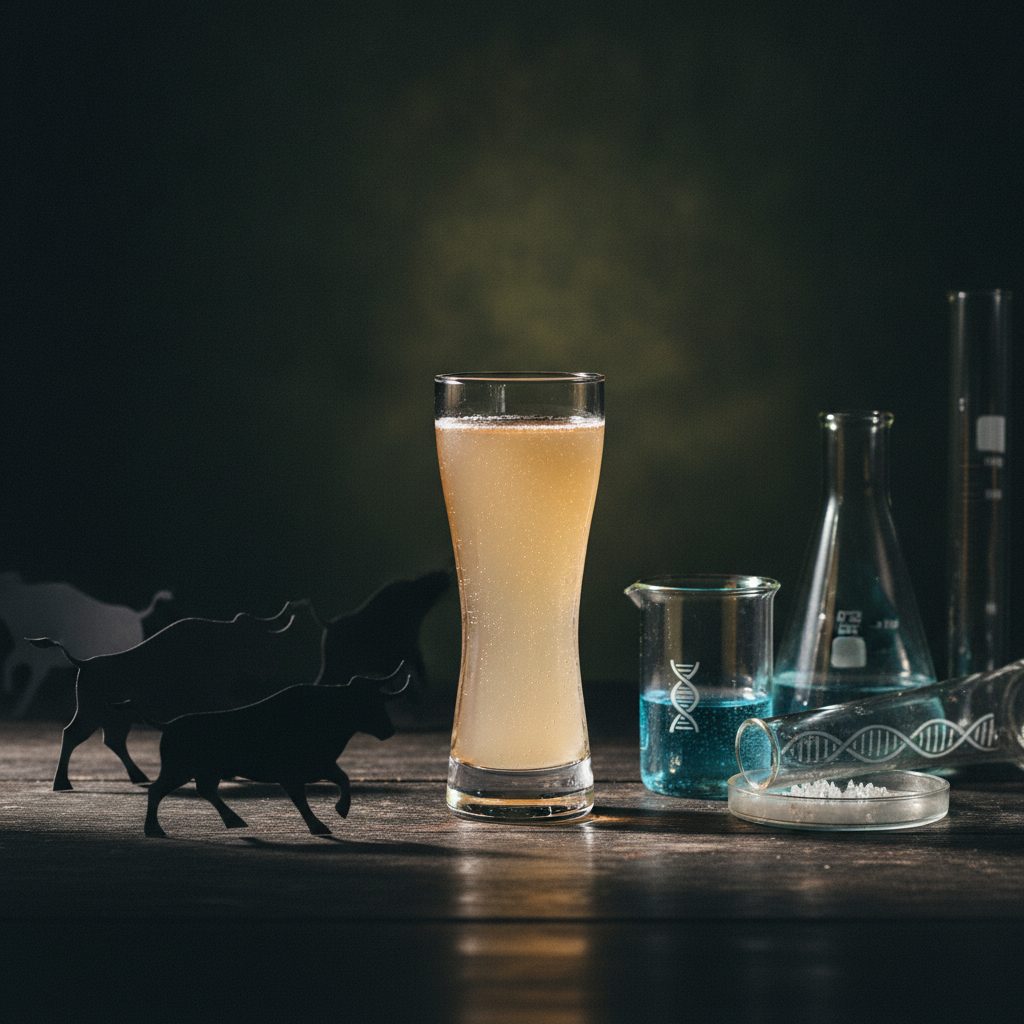
From ox bile to Red Bull to your supplement shelf
Taurine has one of the more colorful origin stories in the supplement aisle. It was first isolated in 1827 from — brace yourself — ox bile, which is why it's named after Taurus, the bull. That heritage is also the reason a certain energy drink leans so hard on a horned mascot. So no, there's no actual bull in your can, but the marketing team clearly did their homework.
Chemically, taurine (C2H7NO3S) is a sulfur-containing amino acid — though a slightly rebellious one, since it doesn't get built into proteins like most amino acids do. Your body makes some of it on its own, and you top up the rest from food: fish, shellfish, and meat are loaded with it, which is why strict vegans tend to run lower. It quietly does useful jobs all over the body — helping regulate calcium in your cells, supporting bile salts, cushioning your heart and retinas — and for decades almost nobody outside of physiology textbooks gave it a second thought. Then longevity science walked in.
The 2023 study that lit the fuse
In June 2023, the journal Science published a sprawling, genuinely impressive study led by researchers at Columbia University.[1] The headline finding was tailor-made to go viral: blood levels of taurine appeared to drop as animals and people got older — by more than 80% between youth and old age in some measures. And when the team gave middle-aged mice a daily taurine top-up, the animals didn't just look sprightlier; they lived measurably longer, with females gaining around 12% and males about 10% of remaining lifespan. Worms lived longer too, and — the crowd-pleaser — middle-aged monkeys given taurine showed improvements in bone density, blood sugar, and markers of liver and immune health.
It was, by supplement-science standards, a blockbuster: multiple species, a plausible mechanism, and a molecule you could buy for pennies. The story practically wrote itself — "the anti-aging deficiency you've never heard of" — and predictably, taurine flew off shelves. On a site like this, that's exactly the moment the little skeptical voice is supposed to pipe up: a single study, however good, is a beginning, not a verdict. Which brings us to the part that doesn't usually make the headlines.
2025: Science hits undo
Here's the thing about the taurine theory. It rested on one load-bearing assumption: that taurine actually declines with age in the first place. If it doesn't, the whole "you're deficient, so replace it" logic wobbles. And in 2025, researchers went back and pressure-tested exactly that assumption — with less flattering results.
In June 2025, a team led by scientists at the National Institute on Aging (part of the NIH) published a paper in Science with a delightfully blunt title: "Is taurine an aging biomarker?"[2] They dug into longitudinal data — the same people sampled repeatedly over years — across humans, monkeys and mice, which is a far stronger design than comparing different young and old people once. The result was almost the opposite of 2023: circulating taurine largely increased or stayed flat with age, rather than falling off a cliff. Taurine levels also varied enormously from person to person, and their links to health outcomes were inconsistent across cohorts. The authors' sober conclusion: taurine is "unlikely to serve as a good biomarker" of aging.
And it wasn't a lone contrarian. Around the same time, an independent group published in Aging Cell with an even more pointed title — "Experimental Evidence Against Taurine Deficiency as a Driver of Aging in Humans."[3] Looking at people directly, they reported that circulating taurine wasn't meaningfully associated with age, muscle mass, muscle strength, physical performance, or mitochondrial function. Two separate teams, two respected journals, same direction of travel: in humans, the tidy "taurine falls with age" story just isn't holding up.
What this does — and doesn't — mean
Now, resist the urge to slam the fridge door and dump your taurine down the sink, because the nuance here matters and it cuts both ways. "Taurine is probably not a good aging biomarker" is not the same sentence as "taurine supplements do nothing." The 2025 studies mostly torpedoed the premise — the idea that everyone is walking around with a worsening taurine deficiency that a pill can reverse. They did not run a giant, years-long trial handing people taurine and measuring who lived longer. That trial is the one that would actually settle things, and reassuringly, versions of it — proper double-blind, placebo-controlled human studies — are underway right now.
So we're in the uncomfortable but honest middle. It's still biologically possible that extra taurine helps some people in some ways; the animal data were real, and taurine does genuine work in the body. What's changed is the confidence. The simple, seductive narrative — you're deficient, top it up, de-age — has taken two solid hits, and the burden of proof has swung back to "show me the human outcomes." Even one of the senior NIH scientists behind the 2025 work has been publicly careful to say this reopens the question rather than closes the book. That's how science is supposed to sound, even if it makes for a worse headline.
The clean verdict
So where does that leave you and your capsule bottle? Refreshingly low-stakes, actually. Taurine's saving grace throughout all of this is that it's cheap and it has a long, boring safety record — it's used in gram-level doses in energy drinks and clinical research without setting off alarms. So unlike, say, an expensive branded molecule with a thin evidence base, taurine isn't going to hurt your body; the only thing at real risk is your wallet's dignity if you bought in expecting a miracle.
Here's the clean framing. If you're already taking a modest dose of taurine, feel fine, and it costs you next to nothing, there's no fire drill — it's low-risk, and the human lifespan trials might yet vindicate it. But if you were reaching for taurine as the anti-aging lever, treating it as a proven fountain of youth on the strength of the 2023 headlines, this is your cue to demote it from "essential" to "interesting experiment we're watching." And please — do not start pounding energy drinks for the taurine. You'd be buying a thimble of an unproven longevity molecule bundled with a bucket of sugar and caffeine, which is roughly the least clean-longevity move imaginable. If you want taurine, eat some fish or take the plain amino acid.
The bigger lesson is the one this whole site keeps circling back to: one spectacular study is a hypothesis wearing a party hat, not a conclusion. Taurine may still earn its place someday when the hard human trials report. Until then, the levers that actually move the needle haven't budged — sleep, resistance training, protein, cardio, sunlight — and none of them care what a bull's bile once contained. We'll update this page the moment the randomized human data land.
Common questions
There's no solid clinical evidence that taurine supplements slow aging or extend human lifespan. The excitement came from a 2023 animal study where taurine extended healthspan in mice, worms and monkeys and lifespan in mice and worms.[1] But in 2025 two independent human studies found that blood taurine doesn't reliably fall with age — it often stays flat or rises[2] — and isn't tied to muscle or aging markers,[3] which undercuts the original "reverse the deficiency" theory. Long-term randomized human trials are still running, so the honest answer is: promising mechanism, unproven in people.
No need to panic either way. The 2025 studies suggested taurine is probably not a good biomarker of aging — they did not show it's harmful. Taurine has a long, reassuring safety record and is used in gram doses in energy drinks and clinical research. What changed is confidence that a taurine pill is an anti-aging intervention, not its safety. If you take it and feel fine, it's low-risk; just don't expect years of extra life, and don't let it crowd out sleep, training and diet.
Chemically it's the identical molecule, taurine (C2H7NO3S). But an energy drink also delivers caffeine and usually a lot of sugar, which drive most of the felt effect and carry their own downsides. Drinking energy drinks for the taurine is a bad trade. If you want taurine, fish, shellfish and meat — or a plain taurine supplement — deliver it without the sugar-and-caffeine baggage.
References
- Singh P, Gollapalli K, Mangiola S, et al. Taurine deficiency as a driver of aging. Science. 2023;380(6649):eabn9257. PubMed: 37289866. doi:10.1126/science.abn9257
- Fernandez ME, Bernier M, Price NL, et al. Is taurine an aging biomarker? Science. 2025;388(6751):eadl2116. PubMed: 40472098. doi:10.1126/science.adl2116
- Marcangeli V, Cefis M, Hammad R, et al. Experimental Evidence Against Taurine Deficiency as a Driver of Aging in Humans. Aging Cell. 2025;24(10):e70191. PubMed: 41061678. doi:10.1111/acel.70191
Study data sourced via PubMed.