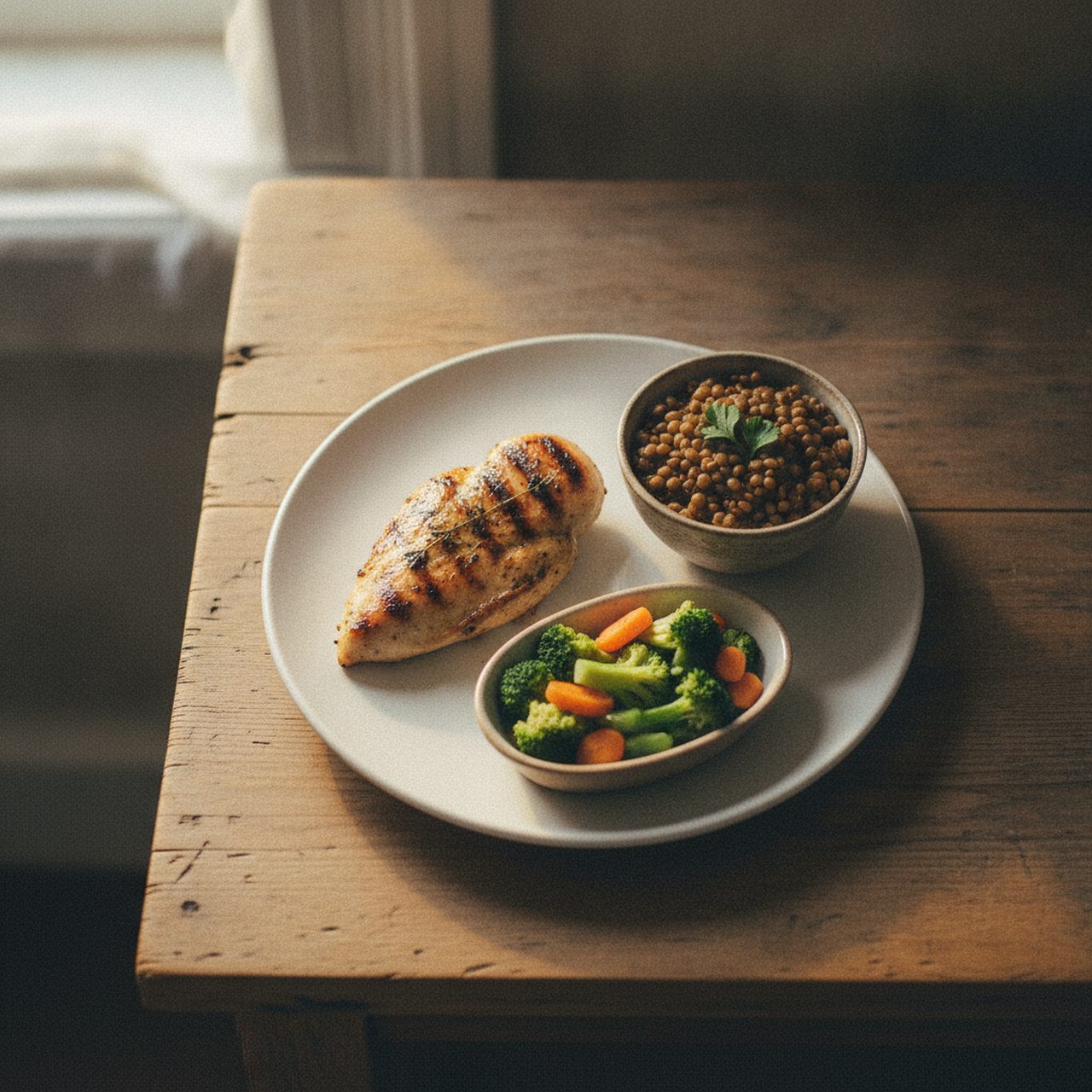
Two headlines, seven months apart, pointing opposite ways
It has been an unusually confusing year to own a kitchen scale.
In January, the USDA and HHS released the 2025–2030 Dietary Guidelines for Americans and quietly detonated the most stable number in nutrition. The Recommended Dietary Allowance for protein — 0.8 grams per kilogram of body weight, essentially unchanged since the Nixon administration — was replaced with a range of 1.2 to 1.6 g/kg.[2] For an 80 kg adult that is a jump from 64 g a day to somewhere between 96 g and 128 g. The protein industry did not have to be asked twice.
Then, on 31 July, Bailey Knopf and Dudley Lamming at the University of Wisconsin–Madison published a synthesis of more than 350 papers on protein restriction and aging.[1] Their conclusion, delivered with the flatness of someone who has read all 350: because most people are relatively sedentary, "many people are likely consuming more protein than they actually need, which probably has negative health consequences."
So: eat considerably more protein, says one official document. Most of you are eating too much, says one large review. Both landed in 2026. Both are defensible. This is what a genuinely unresolved scientific question looks like when it collides with a headline cycle, and it is worth unpicking rather than picking a side.
Why the animal evidence is so aggressively one-directional
Start with the part that is not controversial. In non-human animals, less protein means longer life with remarkable consistency — across flies, worms, mice and rats, and across labs.
The cleanest demonstration is also one of the oldest. In 1993, Norman Orentreich's group fed male Fischer 344 rats a diet in which the essential amino acid L-methionine was reduced from 0.86% to 0.17% — one single ingredient, everything else held constant — and the animals lived 30% longer.[6] Crucially, they ruled out the obvious confounder: the low-methionine rats actually ate more food per unit of body weight, so this was not calorie restriction wearing a disguise.
Three decades later, Lamming's own lab narrowed it further. In 2021 they showed that the metabolic damage attributed to branched-chain amino acids is not a group effort: cutting isoleucine reprogrammed liver and fat metabolism, improved hepatic insulin sensitivity and raised energy expenditure via the FGF21–UCP1 axis. Cutting valine did something similar but weaker. Cutting leucine did essentially nothing.[5] Then in 2023 they ran the long version: restricting isoleucine alone in genetically heterogeneous UM-HET3 mice — a strain chosen specifically because results in one inbred line are notoriously unreliable — reduced frailty and extended lifespan in both sexes, more so in males.[4]
The mechanism is not mysterious, and if you have read our piece on whether rapamycin slows aging, it will look familiar. Amino acids are the cell's most direct signal that food has arrived and it is time to grow. That signal runs through mTORC1, the same nutrient sensor rapamycin blocks pharmacologically. Restrict protein and you nudge mTORC1 down and activate GCN2, which raises FGF21, which improves glucose handling and dials up energy expenditure.[1] Protein restriction is, in effect, the grocery-store version of an mTOR inhibitor — without the mouth ulcers.
Then the humans arrive and ruin the clean story
Here is where the confident version falls apart, and where anyone selling you a "longevity protein protocol" this month should be asked some hard questions.
The single most-cited human dataset is Levine and colleagues' 2014 analysis of NHANES follow-up data.[3] It found that respondents aged 50 to 65 reporting high protein intake had a 75% increase in overall mortality and a roughly fourfold increase in cancer death over the following 18 years. That is the number you have seen on Instagram.
What you have almost certainly not seen is the rest of the same paper:
- The associations were abolished or substantially attenuated when the protein was plant-derived — which points the finger at composition, not quantity.
- In people over 65 the direction reversed: high protein intake was associated with reduced cancer and overall mortality.
- High protein was associated with a fivefold increase in diabetes mortality at all ages.
- Their accompanying mouse work confirmed that a low-protein diet was actively detrimental in very old animals.
The authors' own summary is almost never quoted, which is a shame, because it is the most useful sentence in the field: low protein in middle age followed by moderate-to-high protein in old age may optimise healthspan. Not a rule. A trajectory.
And the observational caveats apply with full force. People eating very high protein in 2014 NHANES were not randomised into that group; they differed in a hundred other ways. This is exactly the kind of evidence that has embarrassed the field before — see our hype detox for a tour of the wreckage.
What the human trials actually did
Short-term and metabolic, is the answer. Human BCAA-restriction studies cut intake by 60–75% for periods ranging from seven days to four weeks and measured markers — insulin sensitivity, mTORC1 signalling in adipose tissue, triglycerides.[1] They found real, measurable improvements. They did not, and could not, measure lifespan. As the review states outright: the effects of protein restriction on human lifespan remain unknown.
There is also a population that keeps getting cited as living proof: traditional Okinawans, whose diet ran at roughly 9% protein with around 80% of calories from plant sources.[1] It is a genuinely interesting data point. It is also a whole culture — activity, social structure, calorie level, sweet potatoes — not a protein intervention.
So who is the high-protein advice actually for?
This is the reconciliation, and it is less dramatic than either headline.
The case for more protein is strongest in exactly the people the restriction literature carves out. The PROT-AGE consensus recommends 1.0–1.2 g/kg/day for adults over 65 to maintain lean mass and function, rising to 1.2–1.5 g/kg in those with acute or chronic illness — with the explicit exception of people with severe kidney disease.[7] Sarcopenia is not a theoretical risk; losing the ability to get out of a chair predicts falls, loss of independence and mortality.
On the training side, the ceiling is well characterised. A meta-analysis of 49 randomised trials with 1,863 participants found that protein supplementation meaningfully improved strength and lean mass during resistance training — but that intakes beyond about 1.62 g/kg/day produced no further gains in fat-free mass.[8] That number deserves to be printed on shaker bottles. The upper end of the new US guideline range and the point of diminishing returns in the training literature are, to a rounding error, the same figure.
| If you are | Reasonable target | Why |
|---|---|---|
| Over ~65, or losing muscle | 1.0–1.2 g/kg, more if ill or training | PROT-AGE consensus; sarcopenia risk outweighs speculative mTOR benefit[7] |
| Resistance training seriously | Up to ~1.6 g/kg | No additional lean-mass gain measured above this[8] |
| Midlife, largely sedentary | No reason to chase the top of the range | Restriction literature; midlife mortality signal[1][3] |
| Pregnant, growing, recovering, under-eating | Do not restrict | Named as potentially harmful in the review itself[1] |
The part that should keep you honest
Applying our usual treatment to a finding we happen to find interesting:
- Zero human lifespan data. Every lifespan number in this article comes from rats or mice. The review's authors say so themselves, and explicitly state their findings "do not establish that older adults should reduce specific amino acids."[1]
- The midlife mortality signal is observational. One dataset, one country, self-reported dietary recall. It is a hypothesis generator, not an instruction.
- Protein leverage cuts the other way. Animals fed low-protein diets compensate by eating more total food, which is why low-protein high-carbohydrate diets are associated with increased fat mass even as they extend lifespan.[9] If you cut protein and let calories drift upward, you may get the worst of both.
- Nobody sells isoleucine restriction, yet. Give it a quarter. "Low-Ile" is going to be a supplement category, and it will be sold on mouse data with a straight face.
- Restriction is not for everyone. The review names the exclusions plainly: pregnancy, children, injury recovery, inadequate calorie intake, and older adults already under-eating protein.
The clean verdict
The most useful thing to come out of July's review is not "eat less protein." It is the demolition of the idea that there is one right protein number for a species that contains both 82-year-olds recovering from hip fractures and 34-year-olds who deadlift twice a week.
The 1.2–1.6 g/kg guideline is good advice for the people it was designed around: older adults defending muscle, and anyone doing resistance training. The restriction literature is a warning aimed at a different person entirely — the sedentary 45-year-old drinking a shake after a day at a desk because a podcast implied that protein is a free good. It is not a free good. It is the loudest growth signal your cells receive, and there is no biological reason to expect that shouting it constantly for forty years is optimal.
What we would actually change on the strength of this: not the total, so much as the source. The one consistent human finding across the whole literature — the plant-protein attenuation in Levine, the 9%-protein Okinawan pattern, the amino-acid specificity in Lamming's mouse work — all point at composition rather than grams. Lentils, beans and soy are lower in methionine than beef and eggs. That is not a moral argument, it is an amino-acid profile, and it is a far cheaper experiment to run on yourself than any supplement. It is also, unsurprisingly, what the food-first evidence keeps saying anyway.
Meanwhile the levers that actually determine whether you keep your muscle into your eighties have not changed and are still free: lift something heavy twice a week. Resistance training is the variable that makes the protein question tractable in the first place — it is what turns amino acids into muscle instead of into a growth signal with nowhere useful to go. We will keep tracking what holds up this year, and if a human protein-restriction trial with hard endpoints ever runs, it will be a genuinely large day. It has not happened yet, and for a study that would need to last thirty years, we would not hold our breath.
If you have decided to lift rather than to restrict — the more defensible option for most people — the other cheap thing worth putting next to the barbell is creatine, where three meta-analyses in older adults landed this year.
One last note for the amino-acid-curious: this is the second time in two months that a single amino acid has turned up as a plausible aging lever. If that pattern interests you, our piece on tyrosine and lifespan covers a 270,000-person dataset pointing in a similar direction — and with similar caveats.
Common questions
There is no single number, and that is the honest answer rather than a dodge. The 2025–2030 Dietary Guidelines recommend 1.2–1.6 g/kg of body weight, up from the long-standing 0.8 g/kg RDA.[2] The July 2026 review argues that range fits active people and older adults training against muscle loss, but that sedentary midlife adults are likely eating more than they benefit from.[1] If you strength train or are over roughly 65, aim high in the range. If you are sedentary and in midlife, there is no evidence that pushing past ~1.6 g/kg buys you anything.
In rodents, high protein reliably shortens lifespan relative to low-protein, high-carbohydrate diets, via mTORC1 and the FGF21 pathway.[1] In humans the evidence is weaker and entirely observational: the most-cited analysis found adults aged 50–65 reporting high protein intake had a 75% increase in overall mortality over 18 years — but the association was abolished or attenuated for plant protein and reversed in people over 65.[3] No human trial has tested whether eating less protein extends lifespan, and the review authors state plainly that the effect on human lifespan remains unknown.
Three keep appearing: methionine, isoleucine and valine. Cutting dietary methionine from 0.86% to 0.17% extended male Fischer 344 rat lifespan by 30% in a 1993 experiment that controlled for food intake.[6] Restricting isoleucine alone extended lifespan and reduced frailty in genetically diverse mice.[4] Leucine restriction produced almost no metabolic benefit.[5] This suggests the issue is amino-acid composition rather than protein as a bulk quantity — one plausible reason plant protein looks better than animal protein in human cohorts.
References
- Knopf BA, Lamming DW. The hallmarks of protein and amino acid restriction in aging and longevity. Cell Press Blue. 2026;100079. Published 31 July 2026. doi:10.1016/j.cpblue.2026.100079. Summary: University of Wisconsin–Madison release
- U.S. Department of Agriculture and U.S. Department of Health and Human Services. Dietary Guidelines for Americans, 2025–2030. Released 7 January 2026. Full text (PDF)
- Levine ME, Suarez JA, Brandhorst S, et al. Low protein intake is associated with a major reduction in IGF-1, cancer, and overall mortality in the 65 and younger but not older population. Cell Metab. 2014;19(3):407-17. PubMed: 24606898. doi:10.1016/j.cmet.2014.02.006
- Green CL, Trautman ME, Chaiyakul K, et al. Dietary restriction of isoleucine increases healthspan and lifespan of genetically heterogeneous mice. Cell Metab. 2023;35(11):1976-1995.e6. PubMed: 37939658. doi:10.1016/j.cmet.2023.10.005
- Yu D, Richardson NE, Green CL, et al. The adverse metabolic effects of branched-chain amino acids are mediated by isoleucine and valine. Cell Metab. 2021;33(5):905-922.e6. PubMed: 33887198. doi:10.1016/j.cmet.2021.03.025
- Orentreich N, Matias JR, DeFelice A, Zimmerman JA. Low methionine ingestion by rats extends life span. J Nutr. 1993;123(2):269-74. PubMed: 8429371. doi:10.1093/jn/123.2.269
- Bauer J, Biolo G, Cederholm T, et al. Evidence-based recommendations for optimal dietary protein intake in older people: a position paper from the PROT-AGE Study Group. J Am Med Dir Assoc. 2013;14(8):542-59. PubMed: 23867520. doi:10.1016/j.jamda.2013.05.021
- Morton RW, Murphy KT, McKellar SR, et al. A systematic review, meta-analysis and meta-regression of the effect of protein supplementation on resistance training-induced gains in muscle mass and strength in healthy adults. Br J Sports Med. 2018;52(6):376-384. PubMed: 28698222. doi:10.1136/bjsports-2017-097608
- Le Couteur DG, Solon-Biet S, Cogger VC, et al. The impact of low-protein high-carbohydrate diets on aging and lifespan. Cell Mol Life Sci. 2016;73(6):1237-52. PubMed: 26718486. doi:10.1007/s00018-015-2120-y
Study data sourced via PubMed.